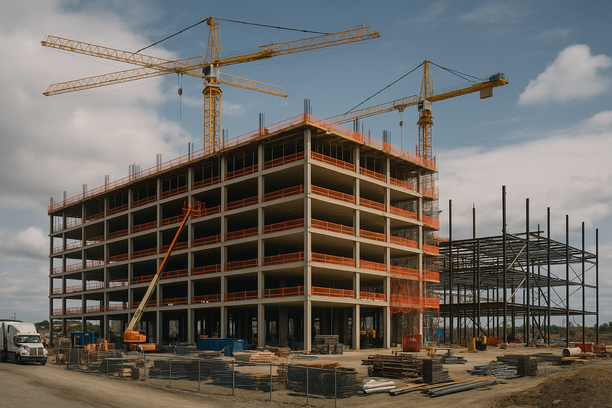

The milestone
A 663,000-square-foot, $1.7 billion laboratory in Albany, New York, has topped out under the Gilbane–Turner joint venture—signaling completion of the structural frame and a shift into the most complex phases of delivery: MEP, clean rooms, high-spec lab build-outs, commissioning, and turnover.
Why this matters to mid-sized firms
Even if you never staff a $1.7B job, projects like this set expectations for everyone:
– Labor and subcontractor competition intensifies
– Owners demand rigorous data, safety, and compliance
– Digital integration across scheduling, cost, quality, and turnover becomes table stakes
Topping out: what changes now
1) Structural risk down, systems risk up
– Structural hazards recede; coordination density rises
– Expect advanced HVAC, filtration/exhaust, specialty gases/vacuum, redundant power, vibration control, and integrated controls
– Project controls, RFIs, submittals, and cost tracking must tighten to manage design clarifications and change events
2) Cash flow peaks and shifts
– Structural costs are largely booked; interiors and MEP mobilize
– Match field progress to billing and cash needs
– Keep AP/AR cadence aligned to procurement release and onsite advancement—or risk avoidable strain
3) Schedule compression and trade stacking
– Enclosure and parallel floor build-outs accelerate
– Early turnover areas drive sequence pressure
– Multiple trades share zones; precise handoffs limit rework and claims exposure
Why high-tech labs raise the bar
– Higher upfront complexity: tighter tolerances, vendor coordination, performance criteria
– Longer commissioning/validation: protocols, documentation, and digital handover quality
– Sophisticated owners: universities, pharma, tech, P3s with strong reporting expectations
Lessons for construction leaders
1) Integrated delivery and partnerships
– JVs combine capacity, bonding, and expertise
– To partner well, standardize finance and project controls so data and processes interoperate
2) Data-driven cost management
– Track VE, allowances, and changes in real time
– Align cost codes to WBS/schedule for clear earned value and forecast accuracy
– Eliminate spreadsheet silos; make field-to-office updates continuous
3) Documented risk and changes
– Expect design evolution: end-user refinements and equipment shifts
– Win with timely RFIs, thorough change documentation, and clean audit trails
Turning pressure into advantage: a readiness checklist
– Cost structure: unified cost codes, live job costing, monthly forecasts that tie to schedule
– Field-to-office loop: daily reports, quantities, and timesheets that feed billing and forecasts
– Change discipline: log events early, price impacts fast, and secure approvals
– Schedule integrity: short-interval planning, trade stacking rules of the road, and variance tracking
– Closeout/turnover: as-builts, O&M, test/commissioning records, and digital handover packages prepared from day one
Bottom line
Mega-labs like Albany’s are redefining expectations for rigor, data transparency, and delivery speed. Firms that forecast risk before it hits the P&L, maintain bulletproof documentation, and keep schedules and cost codes in lockstep can step confidently into higher-spec, higher-margin work—whether as prime, CM, or specialized trade partner.
Source: Construction Owners Report coverage of the Gilbane–Turner JV topping out a $1.7B laboratory in New York: https://www.constructionowners.com/news/gilbane-turner-jv-tops-out-1-7-billion-new-york-laboratory