New York’s design and construction pipeline is shifting in ways that matter to architects, planners, and construction leaders. Three interlocking developments stand out:
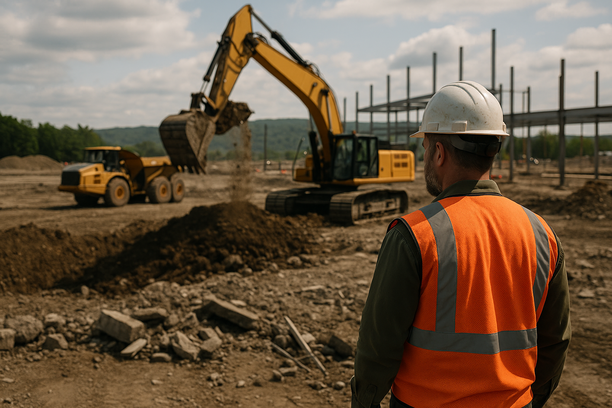
• Colas must sell four facilities in New York to preserve competition in road construction and materials.
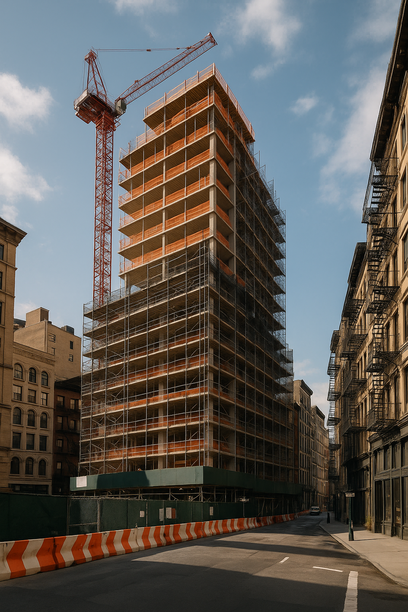
• The $1.7 billion Wadsworth Center laboratory in Albany has reached its topping-out milestone.
• GlobalFoundries is planning two new semiconductor fabrication plants in New York, totaling roughly $21 billion.
Together, these moves signal a deeper transformation: infrastructure competition, public health resilience, and domestic chip manufacturing will shape workloads, standards, and delivery for years to come.
1) Colas ordered to sell four facilities: Competition in roadwork gets real
What’s happening
Regulators are requiring Colas to divest select NY facilities to maintain competitive bidding, stabilize materials pricing, and ensure multiple qualified players can pursue DOT, municipal, and regional work. The message is clear: New York’s infrastructure market is too vital to be dominated by a few vertically integrated conglomerates.
Why it matters for architects and planners
• Cost assumptions: More competition can moderate unit pricing for paving, resurfacing, and sitework—improving early-stage cost models for campus, civic, and mixed-use projects.
• Schedule reliability: A broader pool of road/materials contractors reduces bottlenecks that delay civil milestones.
• Design optionality: Competitive markets reward alternative pavements, complete streets, and greener roadway solutions.
2) $1.7B Wadsworth Center tops out: A new era for public health architecture
About the project
The Wadsworth Center consolidates NY’s public health and biomedical labs into a high-performance, resilient complex supporting advanced diagnostics, BSL research, and rapid response to emerging threats. It is critical infrastructure on par with power and water systems.
Architectural and planning implications
• Structural demand for life science: Post-pandemic investments are long-term, requiring flexible, modular, tech-forward planning.
• High-containment expertise mainstreams: BSL-2/3 planning, pressure cascades, specialized MEP, and redundant life safety are now core skills.
• Urban integration: Secure facilities must connect to the city fabric—balancing circulation, access control, and public interface with resilience in utilities and transit.
• Sustainability vs. intensity: Labs are energy-hungry; meeting climate goals requires advanced envelopes, heat recovery, and smart systems.
3) GlobalFoundries’ two new fabs (~$21B): The chip boom comes home
Why it’s a big deal
Semiconductor fabs are among the most complex facilities built—demanding extreme vibration control, ultra-clean environments, robust power, and high-redundancy water/waste systems. The expansion aligns with U.S. re-shoring of chip production, with New York’s Capital Region as a strategic hub.
Built-environment implications
• Regional infrastructure: Grid capacity, substations, water sourcing/ treatment/ reuse, and 24/7 mobility planning must scale with workforce flows.
• Specialized industrial architecture: Precise structural grids, isolation slabs, mechanical penthouses, and dense below-grade services—plus supplier sites, R&D satellites, training centers, and workforce housing.
• Economic ripple effects: Supply chains, startups, and academia catalyze mixed-use districts, expanded campus facilities, and long-range transit upgrades.
• Sustainability pressure: Aggressive water recycling, renewable energy integration, and careful land stewardship will be scrutinized.
What this cluster means for NY design firms
• Regulatory oversight in infrastructure markets will influence budgets and delivery.
• Science and health resilience is now a civic priority, elevating lab and complex MEP planning.
• Domestic manufacturing is resurging, expanding demand for high-tech industrial typologies.
Action items for practice leaders
• Build or deepen capabilities in lab planning, cleanrooms, and high-containment design.
• Partner early with MEP, process, and commissioning specialists; align BIM/VDC with cost and schedule controls.
• Prepare for infrastructure-scale coordination (power, water, mobility) and performance-based sustainability.
• Invest in agency, institutional, and advanced manufacturing relationships alongside private work.
Looking ahead
New York’s current moves aren’t just big numbers—they’re strategic choices: protect competition and value in infrastructure, build permanent public health capacity, and anchor national semiconductor resilience in the state. Staying current on the Colas divestiture, Wadsworth’s progress, and GlobalFoundries’ fabs is essential to positioning your teams and proposals for the next decade of work.
Source: New York Construction Report – Architecture/Planning (https://www.newyorkconstructionreport.com/category/architects/)