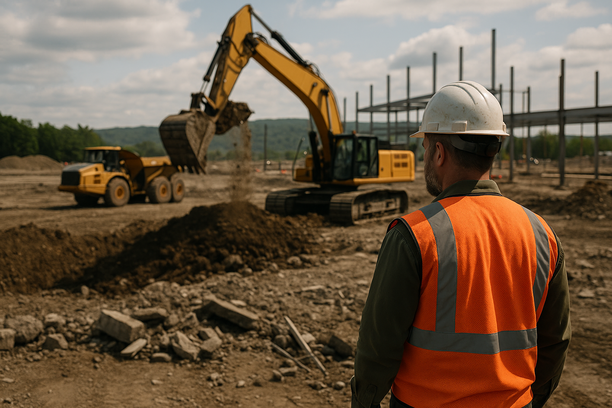
A “ground-raising” instead of a groundbreaking is underway at the former BAE Systems site in the Town of Union, just outside Binghamton in New York’s Southern Tier. According to the New York Construction Report (news home page, October 9, 2026), the plan is to elevate approximately 16 acres to move the property above known flood risk and prepare it for new economic use.
What’s happening
– Raising roughly 16 acres with engineered fill and site-raising techniques
– Reducing flood risk to enable safe future occupancy
– Preparing a resilient, investable platform for commercial, industrial, or mixed-use redevelopment
Why a ground-raising?
– Flood risk is now a first-order constraint: repeated severe storms, remapped floodplains, and tighter insurance/financing standards require higher elevations for critical land.
– Unlocking stranded assets: many legacy industrial sites sit in vulnerable valleys; lifting grades converts liabilities into redevelopable property.
– Visible commitment to resilience: the ceremony signals policy alignment and modern risk standards for future tenants and investors.
Engineering and construction implications
– Geotechnical and hydrological analysis: understand bearing capacity, settlement, groundwater, and downstream drainage impacts before moving a yard of fill.
– Fill sourcing and placement: coordinate large volumes of clean, suitable material; manage trucking and staging; compact in layers to meet design densities with rigorous testing.
– Utilities, access, and stormwater: re-route or extend utilities, regrade roads and sidewalks, and redesign stormwater systems for new elevations and slopes.
Why it matters beyond the Town of Union
This project reflects a national shift toward climate-resilient redevelopment—elevating flood‑exposed sites so they can support long-term growth. Similar strategies are emerging in coastal neighborhoods, riverfront districts, and former manufacturing corridors. The former BAE Systems site offers a case study in aligning environmental risk management, economic redevelopment, and land-use planning.
What this means for mid-sized construction firms
– Bigger, more complex civil scopes: earthwork, utilities, and site infrastructure are central to resilience.
– Tighter compliance and reporting: funders and municipalities expect proof of standards, testing, and outcomes.
– Longer horizons: site platforms set the stage for multi-phase, future-ready vertical development.
Operational excellence is decisive
Margins and reputation hinge on precision: track fill quantities, compaction tests, change orders, and cost codes cleanly; keep field data synchronized with the back office; and forecast with confidence. Firms that pair field expertise with rock-solid controls will be positioned to win and deliver climate-ready work.
Why this is a bellwether
– Yesterday’s industrial footprints must be re-engineered for today’s climate realities.
– Local governments can turn flood-damaged liabilities into prepared, investable assets.
– Construction and engineering teams are the linchpin for technically complex resilience projects.
Reference
New York Construction Report – News home page, October 9, 2026