New York City’s commercial construction pipeline just got a major jolt from four big moves announced and advanced in early September 2026. Together they signal where NYC is headed: massive transit investment, high-rise density in core districts, and long-deferred infrastructure repairs finally moving forward.
The four headline developments
– MTA issued an RFQ for the final contract on the $6.97B Second Avenue Subway Phase 2
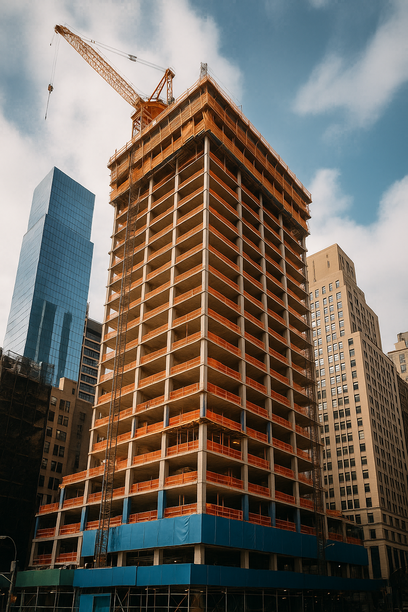
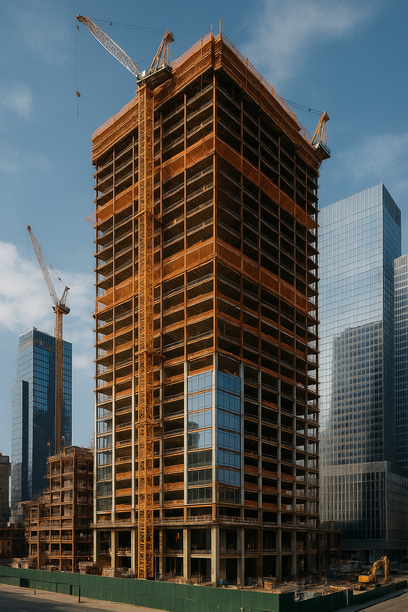
– 8 Carlisle Street topped out at 789 ft in the Financial District
– NYC DOT advanced a $4B rehabilitation of BQE Central
– Amtrak began major construction on a $1B+ Sunnyside Yard rail upgrade in Queens
Second Avenue Subway Phase 2: The $6.97B transit engine
Phase 2 extends the Q line north from 96th Street through East Harlem, with new stations around 106th, 116th, and 125th Streets. The work blends tunneling, heavy civil, systems, and accessibility in one of the tightest urban environments in the world.
What it involves:
– New stations, ventilation, and ancillary buildings
– Tunneling and major utility relocations
– Complex coordination with active subway operations, street traffic, and neighborhood activity
Why the final-contract RFQ matters now:
– Scope is crystallizing and delivery strategies are being locked in
– Prime and specialty teams will form and secure capacity for years
– Transit will anchor NYC’s heavy civil market well into the 2030s
8 Carlisle Street: A 789-foot signal from Lower Manhattan
The tower’s top-out confirms that private development remains active in core markets.
Why this milestone matters:
– Transition from structure to envelope, MEP, interiors, and fit-out
– Rising demand for curtain wall, glazing, high-rise MEP, fire protection, and interiors
– A strong reference point for future towers and value engineering across the city
BQE Central: A $4B bet on essential infrastructure
The Brooklyn-Queens Expressway’s central segment is a citywide lifeline for freight and commuters. The rehab will be complex, visible, and multi-year.
Likely scope and challenges:
– Structural repair or replacement of aging viaducts and retaining elements
– Deck rehabilitation, waterproofing, drainage, and safety upgrades
– Potential lane and ramp reconfigurations
– Intensive traffic staging and detours to keep the corridor moving
Why it is a big deal:
– Region-wide logistics and commute impacts
– High public scrutiny on schedule, safety, and cost
– Steady demand for structural, bridge, highway, traffic control, pavement, and utility crews
Sunnyside Yard: Amtrak’s $1B+ rail upgrade in Queens
Sunnyside is among the busiest yards in the U.S., serving Amtrak, NJ Transit, and LIRR with connections to Penn Station and the Northeast Corridor.
What is at stake:
– Track and interlocking modernization; signal and power upgrades
– Structural renewals to boost capacity and reliability
– Work executed around live rail with tight safety windows and complex phasing
Regional importance:
– Ripple effects on on-time performance across the Northeast Corridor
– A platform for future growth and potential redevelopment in and around Long Island City
Why this wave matters to NYC construction firms
Taken together, these projects point to a market defined by transit and rail megaprojects, high-rise private development, and unavoidable highway rehabilitation.
Implications for 30–100 employee contractors and specialty trades:
– Backlog opportunity: Multi-tier subcontracting and specialty scopes will flow down from megaprojects
– Resource strain: Tight labor, materials, and equipment markets will reward firms with rigorous forecasting
– Coordination pressure: Dense, live, publicly scrutinized jobs demand airtight safety, documentation, and compliance
Practical next steps
– Track RFQs, RFPs, and prequalification windows; form teaming agreements early
– Strengthen labor plans, safety programs, and QA/QC to meet agency expectations
– Upgrade cost control, schedule reporting, and field-to-office data flow
– Build supplier and specialty trade redundancies to buffer volatility
SEO-focused recap
From the $6.97B Second Avenue Subway Phase 2 RFQ and the $4B BQE Central rehabilitation to the 789-foot top-out at 8 Carlisle Street and Amtrak’s $1B+ Sunnyside Yard upgrade, NYC is entering a new era of large-scale building and rebuilding. These initiatives will shape mobility, density, and the contractor workload for the next decade. Firms that align workforce, partnerships, and systems now will be best positioned to capture margin, manage risk, and deliver when it matters most.