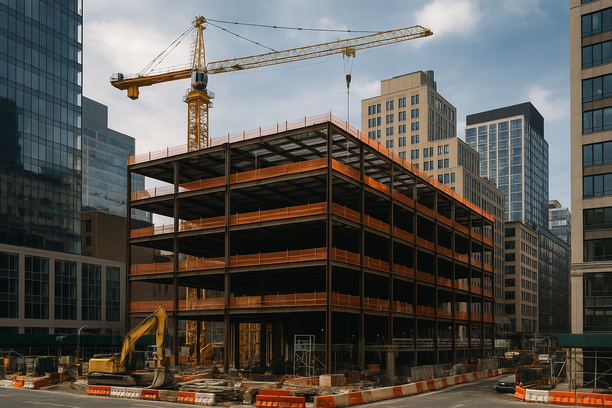
August 2026 in New York: Construction Hits and Policy Shifts
New York’s commercial construction scene is as dynamic as ever. Governor Kathy Hochul has enacted a one-year moratorium on large data centers—projects exceeding 50 megawatts that haven’t yet pulled permits—while development deals, permits, and industrial milestones continue to stack up. July saw $209 million in transactions, new multifamily filings landed across Brooklyn and Queens, and a 100,000-square-foot warehouse on Bruckner Boulevard in the Bronx is nearing completion.
This overview explains what these developments mean for construction firms, developers, property owners, and service providers—especially teams running projects on Sage 300 CRE or supporting the sector with IT. We’ll unpack the moratorium, spotlight fresh development activity, and connect the dots on how private construction businesses can stay resilient.
Data Center Moratorium: What’s Behind the Pause
The statewide halt to new large-scale data center construction gives policymakers time to assess environmental and infrastructure impacts. Hyperscale data centers are energy-intensive and increasingly compete for industrial land, pressuring local utilities and raising concerns about neighborhood impacts like noise, traffic, and rising rents. For construction firms, this is a pipeline freeze on some of the most complex, high-value projects—highlighting the ongoing tension between New York’s tech ambitions and sustainability goals.
Deals and Development Keep Moving
– BKREA reported $209 million in July closings and three sizable deals under contract, underscoring strong activity in prime corridors. Their August newsletter also flags policy and zoning updates that will shape timelines and design decisions in the year ahead.
– New permits include a 297-unit apartment complex in Downtown Brooklyn and a two-building, 178-unit development in Jamaica, Queens—signals of continued confidence in multifamily and mixed-use demand amid tighter financing.
– A 100,000-square-foot warehouse on Bruckner Boulevard (Port Morris, Bronx) is approaching completion, reflecting e-commerce and last-mile logistics tailwinds.
Across the boroughs, leasing, site trades, and office/retail deals remain active. August roundups from ConnectCRE show momentum spreading beyond Manhattan as the market hunts for value and flexibility.
Why This Matters for NYC Construction Firms and CRE IT
Policy moves like the data center pause directly affect project pipelines, subcontractor coordination, and cash flow—core elements you plan and track in Sage 300 CRE. If your team was preparing to bid on a data center foundation or MEP package, that work may be on hold for at least a year, forcing a fast pivot toward multifamily and logistics opportunities. Meanwhile, developers sprinting to file permits before the next regulatory shift need airtight document control, accurate cost forecasting, and frictionless approvals.
Key Trends Shaping the Market
1) Growth vs. Grid Constraints: Demand for housing, logistics, and advanced infrastructure remains strong, but each wave of construction must fit within utility capacity, environmental standards, and neighborhood priorities. Hence, data centers pause while multifamily and industrial push ahead.
2) Financing, Policy, and Zoning: Incentives, zoning adjustments, and targeted infrastructure are steering capital toward high-need corridors and asset classes. Staying close to City Council actions, DOB filings, and tax credit programs is now essential.
3) Digitization and Automation: Competitive bidding and rapid deal flow leave no room for manual processes. Integrations between project management tools and core accounting (including Sage 300 CRE), mobile time capture, and digital document workflows help reveal which jobs are accelerating, stalling, or at risk.
Frank’s Take: Operate Ahead of the Curve
New York remains a high-stakes construction arena—volatile, policy-driven, and relentlessly active. Firms that win treat disruptions like the data center moratorium as prompts to sharpen forecasting, de-risk pipelines, and double down on compliance.
– Automate wherever possible and keep cost tracking real-time.
– Diversify toward multifamily and logistics to offset paused hyperscale work.
– Maintain tight controls on documents, approvals, and versioning.
– Let your IT stack—and Sage 300 CRE—be the backbone, not the bottleneck.
Reference
https://www.optimalspaces.com/august-2026-new-york-city-new-developments/
Related Sources
– BKREA August 2026 NYC Development Newsletter: https://www.bkrea.com/press/bkrea-releases-august-2026-nyc-development-site-newsletter-featuring-market-intelligence-policy-updates-and-209-million-in-transactions
– The Real Deal NYC Construction Permits: https://therealdeal.com/new-york/2026/08/19/new-york-citys-top-construction-permits-aug-14-2026/
– ConnectCRE NYC Market News: https://www.connectcre.com/story-market/new-york/
Stay tuned for more updates on how NYC policy, zoning, and development can reshape your firm’s trajectory—and how to stay resilient with systems built for this market.