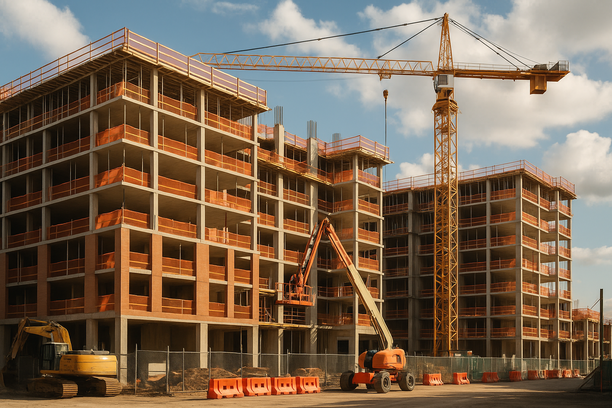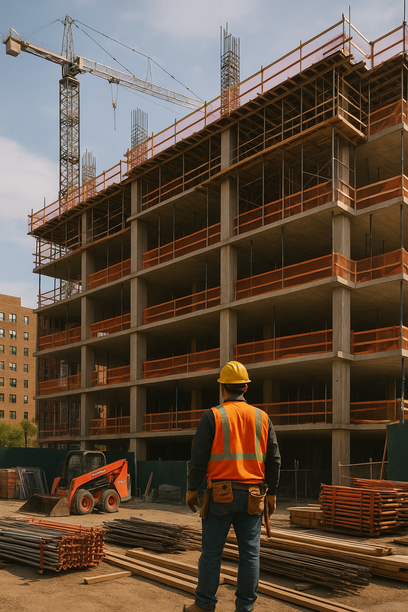
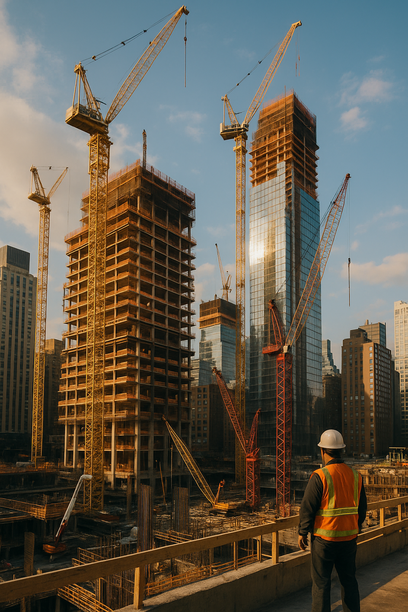
New York City’s commercial construction pipeline just sent a loud signal: the next wave of building is officially underway. A recent roundup identifies 61 verified developments spanning office, industrial, and infrastructure — from Hudson Yards to Midtown, the Financial District, Hunts Point, and critical transportation corridors. For contractors and developers running complex portfolios, this is the competitive landscape for the next 5–7 years.
Snapshot of the pipeline
– Hudson Yards West: long-horizon phases that reinforce sustained demand for high-end commercial and mixed-use construction.
– Midtown projects: multiple near-term completions where interiors, commissioning, and tenant improvements push schedule and cost control to the forefront.
– Financial District towers: multi-year builds that shape labor demand, lease comps, and future tenant fit-outs.
– AmEx HQ at 2 World Trade Center: a 2 million-square-foot, 55-story anchor that caps the WTC campus and signals FiDi’s next phase.
– 460 Park Avenue: a gut-to-frame redevelopment illustrating how owners are re-engineering aging stock for modern performance.
– Hunts Point industrial: fleet-forward, expansion-ready logistics space tailored to last-mile delivery and evolving supply chains.
– Resilience and transit work: Battery Park Underpass flood mitigation and a new head house underscore the growing infrastructure layer that keeps the city moving.
Why this matters now
Lower Manhattan’s next phase: With a global HQ breaking ground at 2 WTC and additional FiDi projects advancing, Downtown remains a magnet for complex, premium work. Expect multi-year demand across trades, technology infrastructure, and future TI cycles.
Midtown re-engineered: Projects like 460 Park Avenue show a shift from incremental renovation to deep repositioning. Rebuilds enable next-gen MEP, energy performance, wellness features, and smart-building tech — but they also heighten logistical complexity and coordination risk in a dense urban context.
Industrial moves closer to the customer: Hunts Point demonstrates how design (covered fleet parking, mezzanines, robust loading, expansion capability) is optimizing for rapid-turn distribution, e-commerce, and potential cold storage. The result: more concrete, steel, envelope, fire protection, and systems work under compressed schedules.
Resilience is core infrastructure: Battery Park Underpass flood upgrades and a new head house reflect long-horizon, multi-agency projects with street closures and intricate phasing. As seas rise and storms intensify, expect more sea walls, pump stations, resilient tunnels, and elevated infrastructure — a durable opportunity for heavy civil and specialty contractors.
The stacked timeline challenge
– Near term (~15 months): Finish-line precision for Midtown handovers; delays ripple through leasing and financing.
– Mid term (~5.2 years): FiDi builds will tie up skilled labor and capital; plan capacity and cash flow early.
– Long term (~6.2 years): Hudson Yards phases demand strategic partner alignment, preconstruction excellence, and disciplined pipeline planning.
Operating playbook for NYC firms
– Capacity and staffing: Map bids to 12–36 month horizons; prequal subs now for constrained trades; develop redundancy for critical scopes.
– Cost control and risk: Tie field progress to cost codes, update forecasts weekly, and enforce change-order protocol to protect margins.
– Schedule integrity: Use look-aheads connected to master schedules; track commissioning and inspections as separate risk items.
– Supply chain: Lock key materials and long-lead systems early; coordinate just-in-time deliveries to reduce site congestion.
– Systems and data: Ensure construction accounting and PM platforms (e.g., Sage 300 CRE or equivalent) integrate job cost, commitments, forecasting, billing, and payroll. Clean data is a competitive advantage when pricing multi-year work.
What to watch next
– Submarket heat: Hudson Yards, FiDi, Midtown, and Hunts Point each show distinct demand profiles; align pursuits with your strengths.
– Delivery cadence: Balance near-term turnovers with mid- and long-term pursuits to avoid overextending labor and capital.
– Compliance and documentation: Expect heavier requirements across safety, sustainability, and commissioning — especially on resilience and transit jobs.
Bottom line
These 61 developments are not just headlines; they are a working roadmap for the industry. Firms that align capacity, partners, and back-office systems to this pipeline will be positioned to win — and deliver — as New York builds its next chapter.
Sources and further reading
– Project roundup: https://www.oftmw.com/markets/new-york/
– Architecture and design coverage: https://www.6sqft.com/category/architecture-and-design/
– Industrial and market updates: https://rebusinessonline.com/category/northeast/new-york/
– NYC DOT advisories: https://www.nyc.gov/html/dot/html/motorist/weektraf.shtml and https://www.nyc.gov/html/dot/html/motorist/wkndtraf.shtml