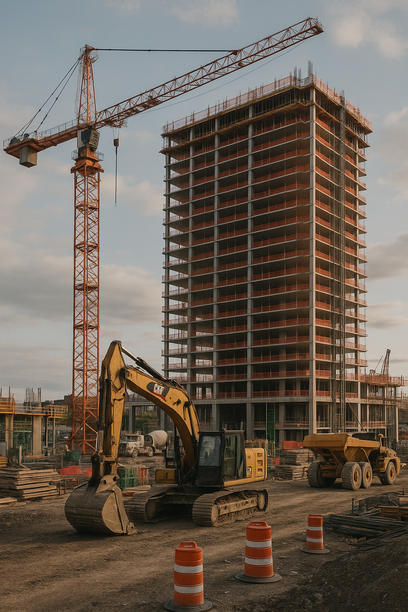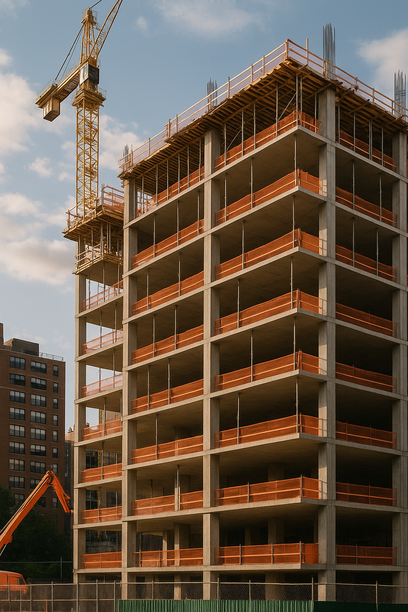
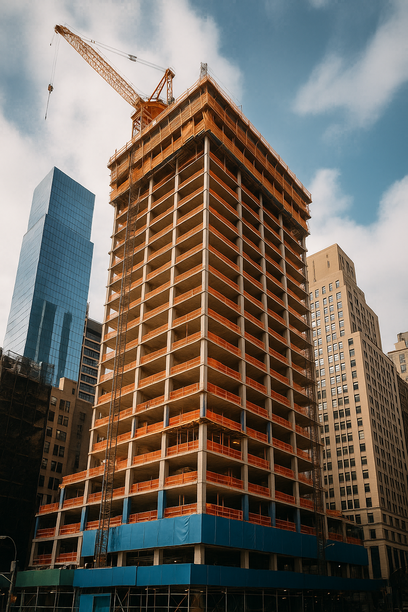
New York City’s construction engine is running hot again.
According to September 2026 filings, 5,496 construction projects were submitted across the five boroughs, including 5,168 alteration filings, 295 new buildings, and 33 full demolitions. These numbers come from the latest snapshot of NYC commercial construction activity, which tracks filings by the date paperwork was submitted — not when shovels hit the ground. That means what we’re seeing on paper now is the front edge of what will shape New York’s built environment over the next two to five years.
Beyond the raw count, four standout projects define where the city is pouring its time, money, and political will:
– The MTA’s Second Avenue Subway Phase 2 (RFQ for a $6.97B final contract)
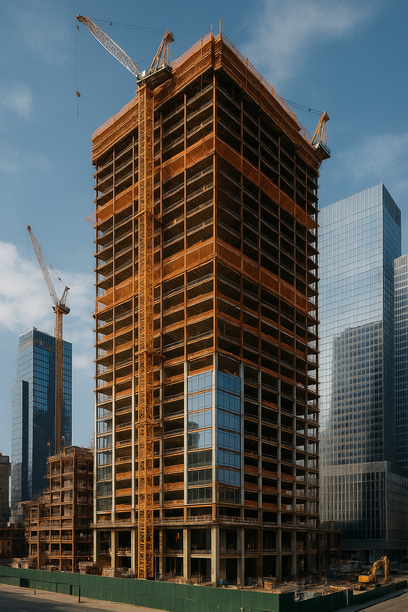
– The topping out of 8 Carlisle Street, a 789-foot tower in the Financial District
– NYC DOT’s $4 billion rehabilitation of the BQE Central corridor
– Amtrak’s $1 billion-plus Sunnyside Yard rail upgrade in Queens
Each of these sits inside that broader wave of filings and offers a window into how transportation, infrastructure, and high-rise development are evolving in NYC right now.
NYC’s September 2026 Filings by the Numbers
– Alterations dominate: 5,168 alteration filings vs. 295 new buildings. In a mature city, upgrading and repurposing existing stock is often the fastest path to value.
– New buildings remain strong: 295 new building filings still represent a significant pipeline for residential, commercial, and mixed-use projects.
– Demolitions are strategic: Only 33 full-demolition filings, suggesting targeted teardowns rather than widespread clear-cutting.
Crucially, the data tracks filing date, not the start of physical work. For owners, contractors, and consultants, that means today’s filings are tomorrow’s mobilizations. Cash flow, labor planning, permits, logistics, and financing all begin to crystallize as these filings move through review and approval. High activity in filings is often a leading indicator of rising construction volume, tighter schedules, and more competition for talent and materials.
Mega-Project #1: Second Avenue Subway Phase 2 – Final Contract RFQ
The MTA has issued a Request for Qualifications (RFQ) for the fourth and final construction contract on Phase 2 of the Second Avenue Subway extension, a project with a total value of approximately $6.97 billion.
What Phase 2 Covers
– Extends Q line service north along Manhattan’s East Side, deepening access in long-underserved neighborhoods.
– Signals a shift into full construction mode as major packages for tunnels, stations, systems, and finishes enter the market.
– Pre-screens large joint ventures and highly qualified heavy civil contractors.
Why It Matters
– Increases transit reliability and capacity for East Harlem and the Upper East Side.
– Drives transit-oriented development along the corridor.
– Creates years of construction jobs and subcontracting opportunities, with ripple effects in the local economy.
Mega-Project #2: 8 Carlisle Street Tops Out at 789 Feet
In the Financial District, 8 Carlisle Street has topped out at 789 feet, marking the completion of the structural frame and a shift from shell and core to façade, interiors, and systems.
What Topping Out Signals
– Schedule pressure pivots to MEP installations, vertical transportation, fire/life safety, and interior fit-outs.
– Financing, leasing, and marketing timelines tighten around expected completion dates.
– Despite cyclical concerns, the milestone underscores confidence in downtown high-rise assets and continued skyline densification.
Mega-Project #3: $4 Billion Rehabilitation of BQE Central
NYC DOT is advancing a long-term, $4 billion rehabilitation of the Brooklyn-Queens Expressway (BQE) Central corridor — a structural, multi-phase overhaul of a critical urban expressway.
Why BQE Central Matters
– Addresses structural deterioration (notably around the triple cantilever), safety, and congestion.
– Maturing designs, environmental and community planning, and phased procurement are converging.
– Citywide impacts include regional goods movement, travel time reliability, and opportunities to reconfigure urban highway space to better serve communities.
Mega-Project #4: Amtrak’s Sunnyside Yard Rail Upgrade in Queens
Amtrak has begun major construction on a $1 billion-plus upgrade at Sunnyside Yard, a backbone facility for the Northeast Corridor.
What’s Underway
– Track, signaling, and power improvements to boost capacity and reliability.
– Modernization to support growing traffic and future service expansions.
– A foundation for potential air-rights development and neighborhood planning around the complex.
How This Construction Wave Impacts NYC Firms
– Scale: Multibillion-dollar transit and highway work alongside hundreds of alterations and nearly 300 new buildings.
– Complexity: Heavy coordination among MTA, NYC DOT, Amtrak, private developers, and local communities.
– Duration: Multi-year programs spanning phases and political administrations.
For mid-sized NYC construction firms, this creates both opportunity and risk:
– Opportunity in bidding, subcontracting, and specialty scopes tied to these pipelines.
– Risk in mismanaging cash flow, underestimating compliance and documentation needs, or losing control of costs as schedules stretch.
This is where systems make the difference. When filings spike and megaprojects mobilize, firms with tight project controls, clean financials, and well-integrated platforms (like a properly configured Sage 300 CRE environment) can scale into larger, more complex work without drowning in manual processes. When your backlog grows, you don’t just need more people; you need better leverage on every hour and every dollar.
Reading the Road Ahead
– Alterations show owners investing heavily in existing assets.
– New buildings — and towers like 8 Carlisle Street — confirm the skyline is still climbing.
– Infrastructure megaprojects — Second Avenue Subway Phase 2, BQE Central, and Sunnyside Yard — mark a once-in-a-generation rebuild of NYC’s transit and highway backbone.
For developers, contractors, subs, and construction-focused finance and IT teams, the message is clear: the work is here. The question is whether your operations can keep pace with the scale, scrutiny, and speed of what’s coming out of the ground.
Reference
New York City filings, September 2026 – New York Daily
https://newyorkdaily.net/archive/2026-09