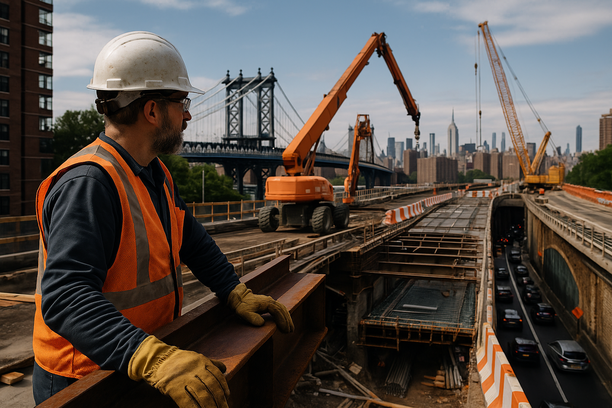
New York City is moving ahead with one of its most consequential infrastructure efforts in decades: a $4 billion, decade-long rehabilitation of the Brooklyn-Queens Expressway (BQE) Central, the critical segment between Atlantic Avenue and Sands Street in Brooklyn. According to New York Build Expo’s Industry News (09/04/2026), NYC DOT plans to keep traffic flowing during construction by using temporary bypass structures while mainline elements are repaired or replaced.
WHY THE BQE CENTRAL REHABILITATION MATTERS
– The BQE is a lifeline for commuters linking Brooklyn, Queens, and Manhattan.
– It carries a significant share of regional freight and logistics.
– Neighborhoods such as Brooklyn Heights, DUMBO, and Cobble Hill are directly affected by its condition and operations.
The BQE Central corridor—especially the triple-cantilever—has long exceeded its intended service life and faces heavy truck loads, chronic congestion, and safety concerns. By committing $4B and more than a decade to a structural overhaul, the city is prioritizing safety, long-term integrity, and continuity of service rather than short-term patches.
HOW TEMPORARY BYPASS STRUCTURES CHANGE THE GAME
NYC DOT’s strategy is to build temporary, parallel or adjacent structures that carry traffic while the mainline is rehabilitated. This approach:
– Minimizes systemic disruption by keeping more vehicles off local streets and secondary routes.
– Improves safety for crews by separating active traffic from primary work zones and enabling more predictable staging.
– Manages complexity through detailed engineering, utility coordination, environmental review, and long-range traffic modeling.
The trade-off is added design and construction complexity, but the benefits—especially for freight reliability and neighborhood impacts—are significant.
BQE CENTRAL IN THE LARGER NYC CONSTRUCTION LANDSCAPE
The BQE project arrives alongside other notable investments, including Amtrak’s $1B+ upgrades at Sunnyside Yard in Queens. Despite a tighter market backdrop, industry reports indicate that construction activity in the New York region remains resilient, particularly within commercial development and large-scale public and quasi-public projects.
Key dynamics to watch:
– A robust pipeline of major public works (BQE, Sunnyside Yard, and others)
– Continued, if selective, private commercial activity
– Heightened focus on risk, capacity, and cash flow management across multi-year programs
COMMUNITY AND ECONOMIC IMPACTS
Neighborhoods adjacent to the BQE have long managed noise, air quality, and visual impacts, plus safety concerns associated with aging structures and heavy truck traffic. A carefully staged rehabilitation can:
– Improve safety margins and reduce emergency repairs
– Enable better noise control, drainage, and design refinements
– Open doors for future urban design and connectivity improvements (subject to final plans)
That said, a decade of construction will bring detours, nighttime operations, and ongoing work zones. Successful outcomes will depend on clear communication, predictable schedules, and meaningful stakeholder engagement.
FREIGHT, LOGISTICS, AND REGIONAL COMPETITIVENESS
For carriers, distributors, and suppliers, the BQE is non-negotiable. The bypass strategy helps maintain throughput, but some delays and phasing impacts are inevitable. Coordinated planning with ports, rail yards, and last-mile hubs will be essential. Proactive rehabilitation now reduces the risk of disruptive emergency closures later and supports long-term economic stability.
WHAT CONSTRUCTION AND BUILT-ENVIRONMENT PROFESSIONALS SHOULD WATCH
– Multi-phase megaproject norms: 10+ year horizons, layered staging, inter-agency coordination
– Real, active infrastructure funding pushing complex work into the market
– Operational continuity as a top design constraint (e.g., bypass structures)
– Non-negotiable project controls: data visibility, forecasting, cost and cash flow management, and disciplined risk allocation
For mid-sized firms, the winners will be selective bidders with tight estimating, billing, and project accounting—and with field data that rolls up to finance in near real time.
THE BIGGER TAKEAWAY
New York City is reinforcing core transportation corridors and modernizing rail infrastructure while sustaining a high baseline of construction activity. The BQE Central rehabilitation exemplifies a build-while-operating mindset: keep the city moving today while rebuilding the backbone for tomorrow.
Source: New York Build Expo – Industry News: New York
https://www.newyorkbuildexpo.com/industry-news-ny