
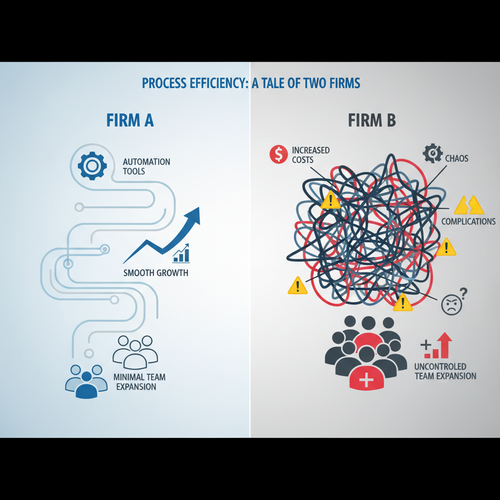
You Can’t Grow 40% Without Hiring. Except You Can.
“We need to hire 3 more people to handle this growth.”
Your CFO nods. Hiring budget approved.
But what if you don’t need them?
The Growth-Hiring Reflex
It’s automatic:
Revenue grows → workload increases → team is stretched → “we need more people”
This logic is so ingrained that questioning it feels irresponsible.
“Of course we need more people. Look at the workload!”
But workload isn’t the problem. Capacity allocation is.
The Hidden Capacity In Your Current Team
Last year, we worked with a wealth management firm doing $680M AUM with 9 advisors and 6 operations staff.
They wanted to grow to $1B AUM.
Their plan:
- Hire 2 more advisors ($300k)
- Hire 2 more operations staff ($180k)
- Total new hiring cost: $480k/year
Before they started recruiting, we asked: “Can we audit your current team’s capacity?”
What we found:
6-person operations team spending:
- 22 hours/week on client reporting (manual data pulling, formatting, distribution)
- 18 hours/week on account maintenance (data entry, updates, tracking)
- 15 hours/week on compliance documentation (manual record-keeping)
- 12 hours/week on meeting coordination (scheduling, prep, follow-up)
- Total: 67 hours/week on automatable work
For a 6-person team working 240 hours/week total, that’s 28% of capacity on work that shouldn’t require humans.
9-person advisor team spending:
- 8 hours/week per advisor on report compilation = 72 hours/week team-wide
- 6 hours/week per advisor on data verification = 54 hours/week team-wide
- 4 hours/week per advisor on administrative tasks = 36 hours/week team-wide
- Total: 162 hours/week on work that’s not client-facing
For a 9-person team working 360 hours/week, that’s 45% of capacity on non-advisory work.
Combined: 229 hours/week across both teams on automatable or administrative work
That’s 5.7 FTE worth of capacity trapped in low-value work.
What We Automated
For operations team:
- Automated client reporting (data pulling, formatting, distribution)
- Automated account maintenance tracking
- Automated compliance documentation
- Automated meeting coordination workflows
Time freed: 67 hours/week → 1.7 FTE
For advisor team:
- Automated report compilation
- Automated data verification checks
- Automated administrative workflows
Time freed: 162 hours/week → 4 FTE
Total capacity unlocked: 5.7 FTE without hiring anyone
The Results (18 Months Later)
Growth:
- Grew from $680M to $1.1B AUM (+62%)
- Original target: $1B
- Exceeded target without hiring
Team:
- Advisors: 9 (no change)
- Operations: 6 (no change)
- New hires: 0
Capacity utilization:
- Advisors: 45% on admin work → 10% on admin work
- Advisors: 55% on client work → 90% on client work
- Operations: 28% on automatable work → 5% on monitoring automation
- Operations: 72% on value work → 95% on value work
Financial impact:
- Avoided hiring cost: $480k/year
- Automation cost: $60k/year
- Net savings: $420k/year
- Plus: 62% growth vs. planned 47% growth
Team feedback:
Managing partner: “We were about to hire 4 people to handle growth we thought was coming. Turns out, we could handle 60% growth with our current team once we freed them from administrative quicksand.”
Senior advisor: “I went from spending half my week on report compilation to spending 90% of my time with clients. Same work hours, completely different output.”
Why Firms Get This Wrong
Mistake #1: Looking at Workload, Not Capacity Allocation
“We have too much work” doesn’t mean you need more people.
It might mean your current people are spending 40% of their time on work that shouldn’t require humans.
Mistake #2: Assuming Hiring Is The Only Growth Lever
Two ways to increase capacity:
- Add more people
- Free up existing people’s time
Most firms only consider option 1.
Mistake #3: Not Calculating the Cost of Hiring
Hiring 3 people costs:
- $300k+ in salaries
- $45k in recruiting costs
- $60k in training/ramp-up time
- $30k in management overhead
- $435k total year one
Automation costs:
- $50k implementation
- $10k annual maintenance
- $60k total year one
Same capacity increase: $435k vs. $60k
7x difference.
Mistake #4: Underestimating Hidden Capacity
Your team has capacity you can’t see:
- Time spent on manual work
- Time spent coordinating
- Time spent on administrative tasks
- Time spent “being busy” but not productive
This capacity is hidden because everyone’s “busy.”
But busy doing what?
The Construction Firm Example
Similar pattern, different industry:
60-person construction firm doing $45M revenue wanted to grow to $60M.
Their plan:
- Hire 2 project managers ($180k)
- Hire 3 project coordinators ($210k)
- Total: $390k in new hires
We audited their capacity:
Current project team (8 people) spending:
- 25 hours/week on status report generation
- 18 hours/week on schedule coordination
- 15 hours/week on budget tracking updates
- 12 hours/week on document management
- Total: 70 hours/week = 1.75 FTE on automatable work
Current PM team (4 people) spending:
- 10 hours/week per PM on data compilation = 40 hours/week
- 8 hours/week per PM on status updates = 32 hours/week
- 6 hours/week per PM on administrative coordination = 24 hours/week
- Total: 96 hours/week = 2.4 FTE on administrative work
Combined: 166 hours/week = 4.15 FTE trapped in low-value work
After automation:
- Grew from $45M to $62M (+38%)
- New hires: 0 (vs. planned 5)
- Savings: $390k/year
- Automation cost: $55k year one, $12k ongoing
Operations director: “We were going to hire our way to $60M. Instead, we automated our way to $62M with the team we had.”
The Pattern
Across 15+ implementations, we see the same pattern:
Before capacity audit:
- Firm plans to hire 3-5 people for growth
- Budget: $300-500k/year
- Timeline: 6-12 months (recruiting, onboarding)
After capacity audit:
- Discover 30-45% of current capacity on automatable work
- Automate that work
- Free up 3-5 FTE equivalent capacity
- Achieve growth target without hiring
- Cost: $50-70k/year (automation)
Difference:
- Same growth outcome
- $250-430k/year lower cost
- Faster (implement automation in 6 weeks vs. recruit for 6 months)
- Zero hiring risk (no turnover, no cultural fit issues)
When You Actually Need To Hire
This isn’t “never hire people.”
You should hire when:
- You need new expertise you don’t have
- You need more client-facing relationship capacity
- You need strategic thinking and creativity
- Your current team is already at 90%+ value-work capacity
You shouldn’t hire when:
- Your current team spends >30% time on automatable work
- You’re hiring for execution capacity, not strategic capacity
- The work is repetitive and rules-based
- You’re hiring because “we’re busy” without analyzing why
The Question To Ask Before Every Hire
Next time you’re about to hire:
“If we automated the low-value work our current team is doing, would we still need this hire?”
If yes: hire (you need new capability)
If no: automate first, then reassess
You might find you can grow 40% without hiring anyone.
You just need to free up the capacity you already have.