
You Have 47 Unpublished Blog Posts. The Problem Isn’t Writing. It’s Publishing.
“We need to create more marketing content.”
Every managing partner says this.
Usually, it’s wrong.
The Content Creation Myth
Here’s what firms believe:
“Our marketing problem is we don’t create enough content.”
So they:
- Hire content writers
- Start content calendars
- Run brainstorming sessions
- Set creation goals
And they create content. Lots of it.
But it sits unpublished.
The Real Problem: Publishing Friction
We discovered this in our own firm.
We were creating content. Blog posts. Market insights. Client resources.
But publishing was sporadic. Inconsistent. Slow.
Leadership kept asking: “Why aren’t we publishing more?”
The marketing team’s answer: “We don’t have time.”
That confused us. The content existed. It was written. It was good.
What was taking so long?
We Audited The Publishing Process
Here’s what we found.
To publish ONE blog post across our channels required:
Step 1: Website Formatting (45 minutes)
- Copy content from Google Doc
- Format in WordPress
- Add proper heading tags
- Insert and optimize images
- Add internal links
- Set categories and tags
- Write meta description
- Preview and adjust
Step 2: Social Media Adaptation (30 minutes per platform × 5 platforms = 150 minutes)
- Rewrite for LinkedIn format and character limits
- Create Twitter thread version
- Adapt for Facebook audience and format
- Create Instagram caption and image
- Ensure each has proper hashtags and mentions
Step 3: Scheduling (25 minutes)
- Open each platform
- Upload content
- Set optimal posting times
- Double-check everything
- Schedule
Step 4: Quality Control (20 minutes)
- Preview on each platform
- Check formatting
- Proofread one more time
- Fix any issues
- Confirm scheduled
Total time to publish one piece of content: 4 hours
No wonder we weren’t publishing daily. Who has 4 hours per day for publishing logistics?
The Math That Changed Everything
Our team was creating 2-3 solid pieces of content per week.
But publishing only 1 every 2 weeks.
Why?
Not lack of content. Lack of time to execute the 15-step publishing process.
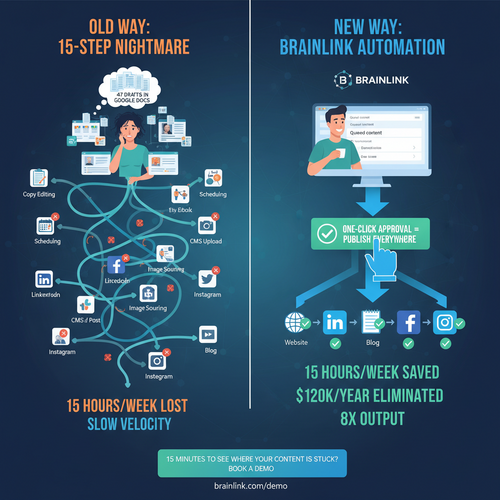
We had 47 drafted blog posts sitting in Google Docs. Finished. Good. Unpublished.
The bottleneck wasn’t creation. It was publishing velocity.
What We Built
We automated the entire publishing workflow.
Here’s how it works now:
Morning (8:00 AM):
- Automation pulls the next queued content piece
- Formats it optimally for each platform
- Sends preview email to marketing lead
- “Review and approve today’s content: [link]”
Marketing Lead Review (15 minutes):
- Reviews formatted content
- Makes any final tweaks
- Clicks “Approve” or “Revise”
Automation (immediate):
- If approved: publishes to website, blog, LinkedIn, Twitter, Facebook, Instagram
- Each platform gets optimally formatted version
- Metadata, tags, hashtags all handled
- Scheduling optimized for each platform
- Done.
Time per piece: 15 minutes (just review/approve)
Time saved: 3 hours 45 minutes per piece
The Results (6 Months Later)
Before Automation:
- Publishing frequency: ~2 posts/month
- Time spent on publishing: 15 hours/month
- Marketing team bandwidth: maxed out
- Content backlog: 47 unpublished pieces
- Marketing effectiveness: sporadic, inconsistent presence
After Automation:
- Publishing frequency: 20-25 posts/month
- Time spent on publishing: 6 hours/month (review only)
- Marketing team bandwidth: 60% capacity freed
- Content backlog: 0 (publishing faster than creating)
- Marketing effectiveness: consistent daily presence
Financial Impact:
- Hours saved: 15 hours/week = 780 hours/year
- At fully loaded cost of $85k/year for marketing coordinator = $154/hour
- Value: $120,000/year
- Plus: eliminated need to hire additional marketing help
Secondary Impact:
- Website traffic: +180% (consistent publishing + SEO)
- LinkedIn engagement: +240% (daily presence)
- Inbound leads: +65% (more visibility)
- Marketing team morale: way up (doing strategy, not grunt work)
What We Learned
Insight #1: Content velocity beats content volume
Publishing 20 good pieces per month beats creating 50 great pieces per year that sit unpublished.
Velocity > perfection.
Insight #2: Publishing friction kills marketing
Every step in your publishing process is a decision point. And decision points create delay.
“Should I publish this now or wait?”
“Should I optimize this more?”
“Should I format it slightly differently?”
Each decision = delay.
Automation eliminates decisions. Content gets published. Done.
Insight #3: Human review is the key
We didn’t fully automate. We kept human review.
Every morning: “Approve or revise?”
This was critical because:
- Marketing lead maintains quality control
- Can catch any automation errors
- Can make last-minute strategic adjustments
- Maintains brand voice consistency
The automation handles execution. Human handles judgment.
Perfect division of labor.
Why This Applies To Your Firm
“But Brainlink, you’re a tech company. We’re a construction firm / family office / RIA. This doesn’t apply to us.”
Wrong.
Every firm has this problem.
You’re creating content:
- Market insights
- Client updates
- Project case studies
- Thought leadership
- Industry analysis
But you’re not publishing it because:
- “We don’t have time”
- “It’s too much work to format for each platform”
- “We’ll get to it next week”
- “We need to optimize it more”
Meanwhile, your competitor who figured out publishing velocity is everywhere. You’re nowhere.
The Pattern
Across every implementation:
Before:
- Content created: ✓
- Content good: ✓
- Content published: ✗ (friction)
After:
- Content created: ✓
- Content good: ✓
- Content published: ✓ (automation removed friction)
Impact:
- Velocity goes up 5-10x
- Time spent goes down 80%+
- Marketing effectiveness goes up dramatically
- Team focuses on strategy, not logistics
What This Means For You
Go look at your Google Docs right now.
How many drafted pieces are sitting there unpublished?
If the number is >5: you don’t have a content creation problem. You have a publishing velocity problem.
The fix:
- Admit the bottleneck is publishing, not creation
- Automate the 15-step publishing process
- Keep human review (quality control)
- Remove human execution (logistics)
- Watch velocity increase 5-10x
The ROI:
Our automation saves us 15 hours/week and $120k/year.
But the real value isn’t cost savings.
It’s market presence. Thought leadership. Inbound leads. Client acquisition.
You can’t buy that. But you can unlock it by removing publishing friction.
The Question You Should Ask
Not: “How do we create more content?”
Ask: “How much content are we creating that’s not getting published, and what’s the friction preventing it?”
Then automate the friction away.
Different question. Different outcome.