
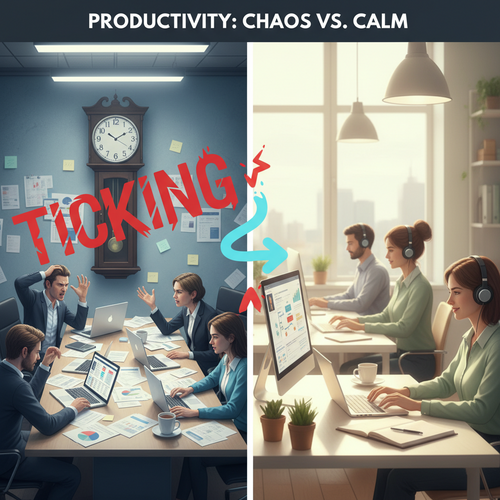
The $17K Meta-Work Tax: How “Work About Work” Is Costing You 40% of Team Capacity
Your operations team isn’t slow.
They’re just spending 40% of their time telling people what they’re doing instead of… doing it.
The Meta-Work Problem Nobody Measures
Research shows that the average knowledge worker spends 60% of their time on “work about work”:
- Communicating about work
- Searching for information
- Managing shifting priorities
- Chasing approvals
Only 40% of time is spent on “skilled work”—the actual job they were hired to do.
At an average salary of $75k, that’s:
$45k/year paying someone to coordinate
$30k/year paying someone to do their actual job
The meta-work tax: $17k per employee per year in wasted capacity.
For a 10-person team: $170k/year spent on coordination overhead.
What Meta-Work Actually Looks Like
We did a time audit for a wealth management operations team last quarter.
Here’s one person’s actual Tuesday:
08:30-09:00: Prep for weekly status meeting
09:00-10:00: Weekly status meeting
10:00-10:30: Write follow-up email summarizing status meeting
10:30-11:15: Update portfolio tracking spreadsheet
11:15-12:00: Actually doing operational work
12:00-12:30: Lunch
12:30-01:00: Respond to “quick status questions” in messages
01:00-02:00: Pull data for weekly client report
02:00-02:30: Format and send client report
02:30-03:00: Meeting with manager about priorities
03:00-04:00: Actually doing operational work
04:00-04:30: End of day status update email
04:30-05:00: Tomorrow’s meeting prep
Total actual operational work: 2.5 hours
Total meta-work (coordinating, reporting, updating): 5 hours
This person is spending 67% of their time telling people what they’re doing.
The Compounding Cost
But here’s what really hurts:
Meta-work doesn’t just consume time. It fragments attention.
That 2.5 hours of “actual operational work” wasn’t 2.5 uninterrupted hours.
It was:
- 45 minutes before getting pulled into a status question
- 35 minutes before needing to update a tracker
- 60 minutes before writing a status email
No flow state. No deep work. Just shallow task-switching.
One operations manager told us:
“I realized I hadn’t had 2 uninterrupted hours of thinking time in 6 months. My calendar was only 30% meetings. But my brain was 70% interrupted by coordination work.”
What We Automated
That wealth management operations team hired us to eliminate meta-work.
Before Automation:
Weekly Status Meeting (6 hours/week team-wide):
- 8 people × 1 hour = 8 hours
- Plus 30 min prep each = 4 hours
- Plus 30 min follow-up = 4 hours
- Total: 16 hours/week = 832 hours/year
Status Update Communications (4 hours/week team-wide):
- End-of-day updates
- Client progress emails
- “Quick FYI” messages
- Total: 4 hours/week = 208 hours/year
Report Generation (5 hours/week team-wide):
- Weekly client summaries
- Performance dashboards
- Portfolio status reports
- Total: 5 hours/week = 260 hours/year
Coordination Questions (3 hours/week team-wide):
- “Where are we on X?”
- “What’s the status of Y?”
- “When will Z be done?”
- Total: 3 hours/week = 156 hours/year
Total meta-work: 1,456 hours/year
For an 8-person team working 2,080 hours/year each = 16,640 total hours
Meta-work percentage: 8.7% of total team capacity
But wait—that’s just the explicit meta-work. The hidden cost is attention fragmentation across the other 91.3%.
After Automation:
Real-time Dashboard:
- Replaces status meetings
- Replaces status update emails
- Replaces “where are we?” questions
- Anyone can check progress anytime
Auto-Generated Reports:
- Pulls data automatically
- Formats to template
- Emails on schedule
- Zero human time
Automated Progress Tracking:
- Captures activity automatically
- Updates project status
- Flags blockers
- No manual input needed
Result: 1,456 hours freed up = 0.7 FTE worth of capacity unlocked
What They Did With The Time
This is the part that matters:
They didn’t reduce headcount.
They redirected capacity to actual operational work.
Before automation:
- 8-person team
- 1,456 hours/year on meta-work
- Effective capacity: 7.3 FTE
After automation:
- 8-person team
- Minimal meta-work
- Effective capacity: 7.9 FTE
They went from a 7.3-person team to a 7.9-person team… without hiring anyone.
The outcomes (6 months later):
- 50% increase in operational project completion
- 40% reduction in “I didn’t have time to get to it” backlog
- 35% improvement in strategic initiative execution
- Zero increase in team stress (actually decreased)
The director told us:
“My team didn’t get more capable. They just finally had capacity to be capable.
Before, we were drowning in coordination overhead. After, we were finally doing the job we were hired to do.”
The “But We Need Status Updates” Objection
Every time we present this, someone says:
“But we NEED status meetings. We NEED progress updates. How else will we know what’s happening?”
Fair question.
But you’re confusing “we need visibility” with “we need humans to manually create visibility.”
You need: Real-time visibility into progress
You don’t need: Humans spending 16 hours/week creating that visibility
Automation gives you better visibility with zero human time:
- Dashboards update in real-time (not weekly in a meeting)
- Progress is always current (not “as of last Friday”)
- Blockers are flagged automatically (not buried in an email)
- Historical trends are visible (not lost after the meeting)
One principal told us:
“I thought I needed status meetings. Turns out I needed status visibility. The meeting was just the inefficient way we were getting it.”
After implementing dashboards: better visibility, zero meeting time.
The Real ROI
Let’s do the math for a 10-person operations team:
Meta-work cost:
- 1,456 hours/year × 10 people = 14,560 hours/year
- At average ops salary of $85k = $51/hour
- Cost: $742,560/year spent on coordination
Automation cost:
- Implementation: $45k
- Annual maintenance: $9k
- Total year 1: $54k
ROI year 1: $688,560
But the real ROI isn’t the time saved.
It’s what the team builds with that time.
One managing partner told us:
“After eliminating meta-work, my operations team shipped 3 strategic initiatives they’d been ‘too busy’ to do for 18 months.
Those 3 initiatives generated $400k in annual value.
The automation didn’t just give us time back. It gave us the capacity to think strategically.”
How To Find Your Meta-Work Tax
Ask your team to track one week:
Every time they:
- Attend a status meeting
- Write a status update
- Pull a report
- Answer “where are we on X?”
- Update a tracker
- Send a coordination email
Track:
- What it was
- How long it took
- Could a system do this automatically?
Add it up.
Multiply by 52 weeks.
If you get a number over 500 hours/year: that’s your meta-work tax.
And it’s costing you way more than the hours.